
Ria October 2026 Portfolio Performance Review
.png)
Ria portfolios recorded mixed performance in October 2026 amid heightened global equity market volatility and a sharp correction in technology-related stocks. Portfolios with higher equity allocations experienced greater declines, while conservative portfolios demonstrated resilience, supported by relatively stable fixed income performance.
.png)
At the fund level, ASN Equity Global declined 6.99%, reflecting weakness in global equities, particularly technology-heavy markets. Meanwhile, ASN Equity Malaysia recorded a more modest decline of 1.56%, while ASN Sukuk gained 0.39%, highlighting its diversification benefits during periods of equity market uncertainty.
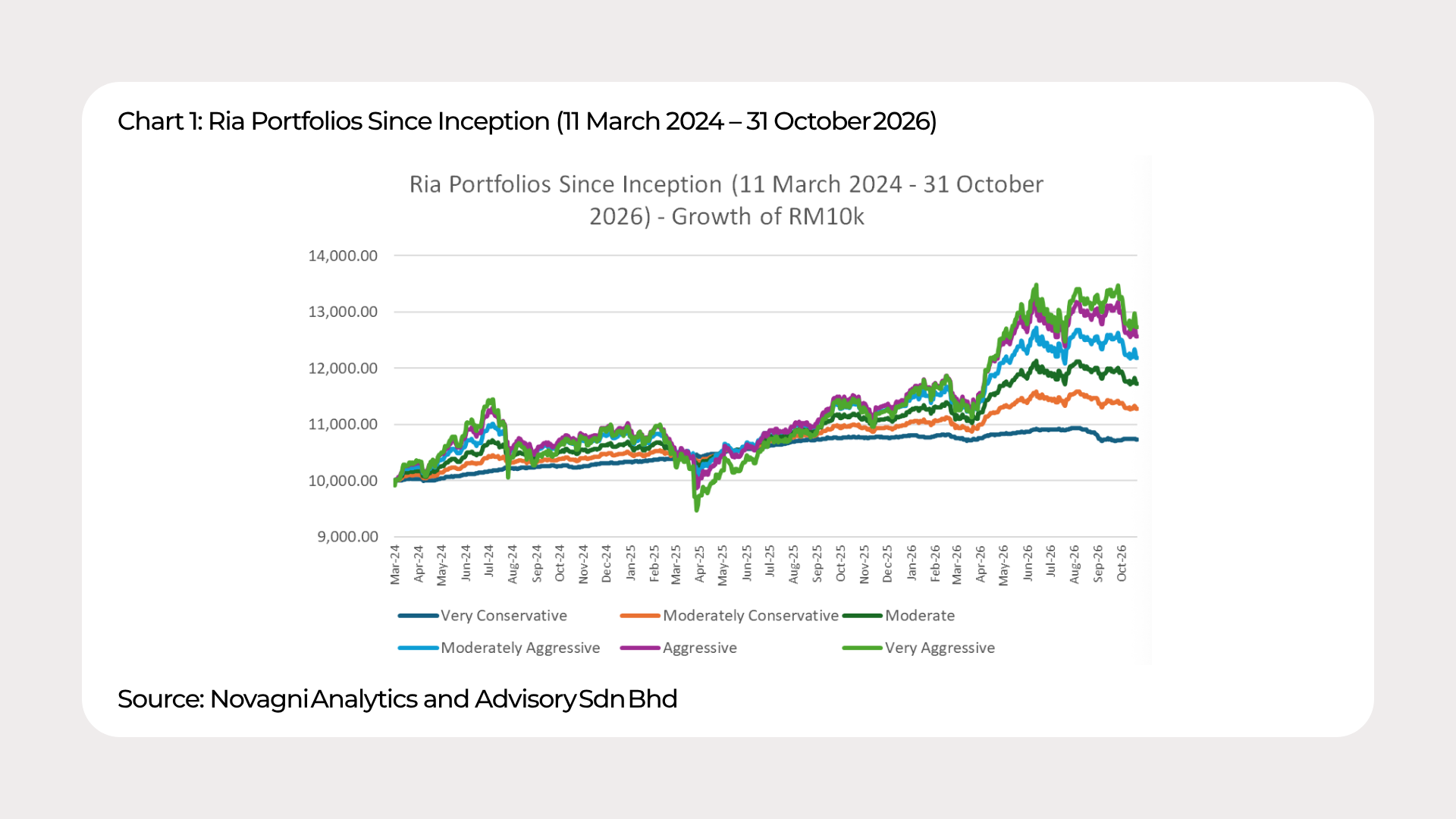
Across Ria's six risk profiles, the Very Conservative portfolio was the only portfolio to record a positive monthly return of 0.17%. Other portfolios declined between 0.95% and 4.18%, with higher-risk portfolios experiencing greater losses due to their larger equity exposure.
Despite October's correction, longer-term performance remained positive, with five of six portfolios recording year-to-date gains ranging from 2.67% to 12.27%. Since Ria's launch, all portfolios have delivered positive cumulative returns ranging from 7.35% to 27.28%, reinforcing the importance of diversification and maintaining a long-term investment perspective amid short-term market fluctuations.
Market Review
Summary
Global financial markets experienced heightened volatility in October 2026, driven by escalating US-Iran tensions, persistent inflationary pressures and uncertainty surrounding global monetary policy. Concerns over elevated technology valuations and the sustainability of AI-related investments also weighed on investor sentiment, triggering broad-based declines across major equity markets, particularly in Asia.
In contrast, global government bonds strengthened as investors sought safer assets amid market uncertainty, resulting in declining sovereign bond yields. Commodity markets delivered mixed performance, with crude oil prices surging 19.30% on geopolitical supply concerns, while gold declined 7.42% amid a stronger US Dollar and expectations of further monetary tightening.
Despite global market weakness, Malaysia demonstrated relative resilience, with the FBM KLCI declining 1.89% and the Ringgit appreciating 0.53% against the US Dollar. Overall, October reflected a shift towards more defensive investment positioning as investors balanced geopolitical risks, inflationary pressures and concerns over global economic growth.
Equity Markets
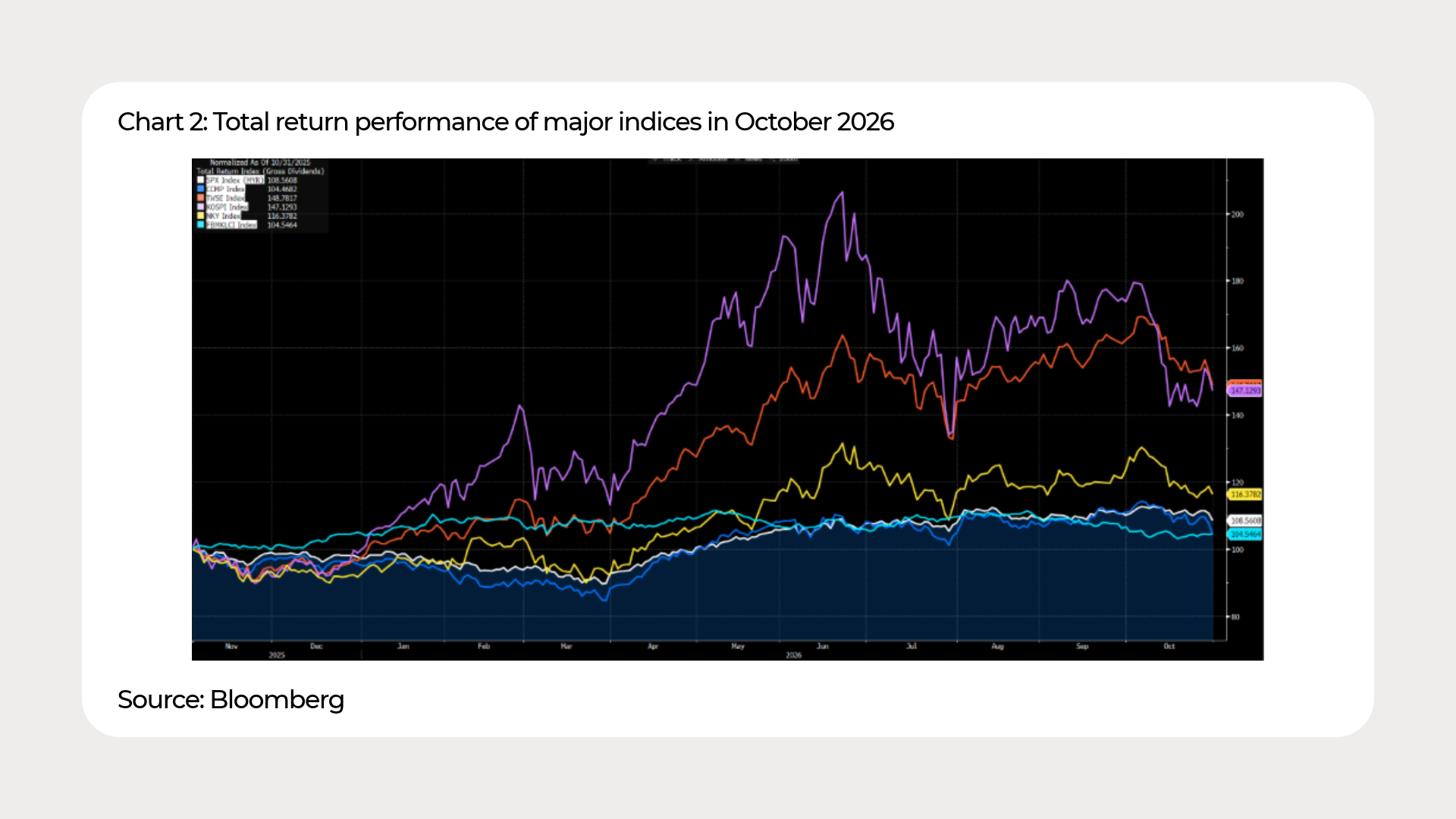
Global equity markets recorded broad-based declines in October as heightened geopolitical tensions, monetary policy uncertainty and concerns over elevated technology valuations weighed on investor sentiment. The sharp correction in AI-related stocks reflected growing caution over the sustainability of capital expenditure and future earnings growth.
Technology-heavy Asian markets experienced the steepest losses, led by South Korea's KOSPI (-15.34%) and Taiwan's TWSE (-8.37%), reflecting their significant exposure to the global semiconductor and AI supply chains. Japan's Nikkei 225 also declined 5.85%, weighed down by technology sector weakness and expectations of further monetary policy normalisation.
In the US, the NASDAQ fell 5.84%, significantly underperforming the broader S&P 500 (-1.45%), as investors reassessed technology valuations following months of AI-driven gains. The divergence highlighted increasing caution towards growth-oriented stocks amid uncertainty over future earnings and interest rates.
Meanwhile, Malaysia's FBM KLCI declined a more modest 1.89%, demonstrating relative resilience compared with regional peers. Its lower exposure to technology stocks, alongside support from domestically oriented sectors and expectations surrounding Budget 2027, helped cushion the impact of the global sell-off.
Overall, October's performance reflected a shift towards more defensive equity positioning, with investors increasingly prioritising earnings resilience and reasonable valuations amid heightened market uncertainty.
Fixed Income
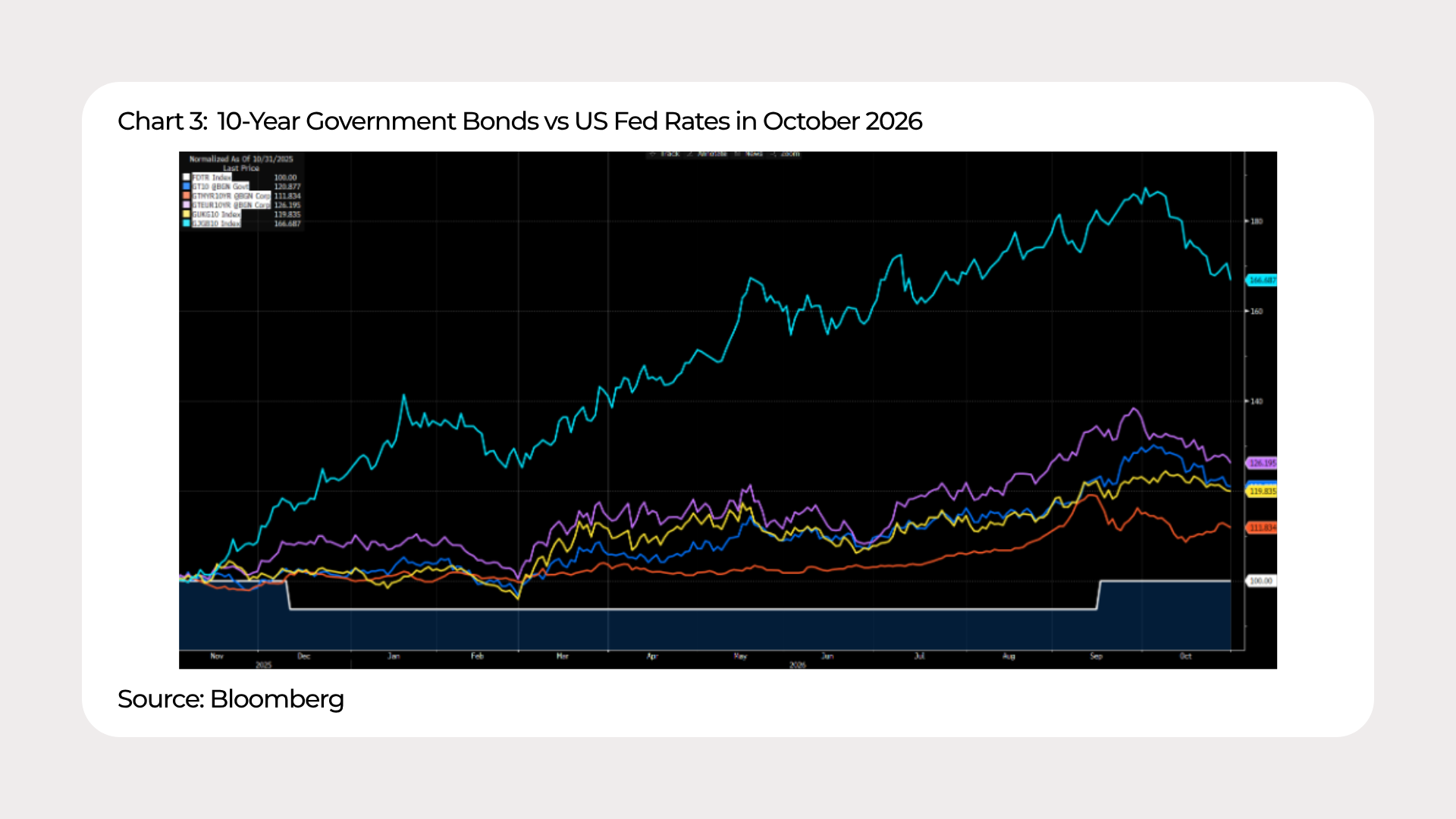
Global bond markets rebounded in October, reversing part of September's sell-off as heightened equity market volatility and concerns over economic growth drove investors towards safer assets. Despite expectations of further monetary tightening, government bond yields declined across major economies, reflecting stronger demand for defensive investments.
The US 10-Year Treasury yield fell by 36 basis points (bps), following a sharp 53 bps increase in September. Similar movements were observed across developed markets, with Japan's 10-Year government bond yield declining 28 bps, followed by the Eurozone (-26 bps) and the UK (-14 bps). The broad-based decline reflected the interplay between safe-haven demand and persistent inflationary pressures on global bond markets.
In Malaysia, the 10-Year Malaysian Government Securities (MGS) yield declined by 13 bps, reflecting the broader global bond market recovery. The relatively modest movement suggested greater stability in domestic fixed income markets, supported by resilient economic fundamentals and a relatively steady monetary policy environment.
Meanwhile, money market instruments continued to provide liquidity and capital preservation options amid uncertain interest rate expectations. Overall, October's bond market recovery reinforced the diversification benefits of fixed income investments, although future performance remains sensitive to inflation developments and central bank policy decisions.
Commodities & Currency Markets
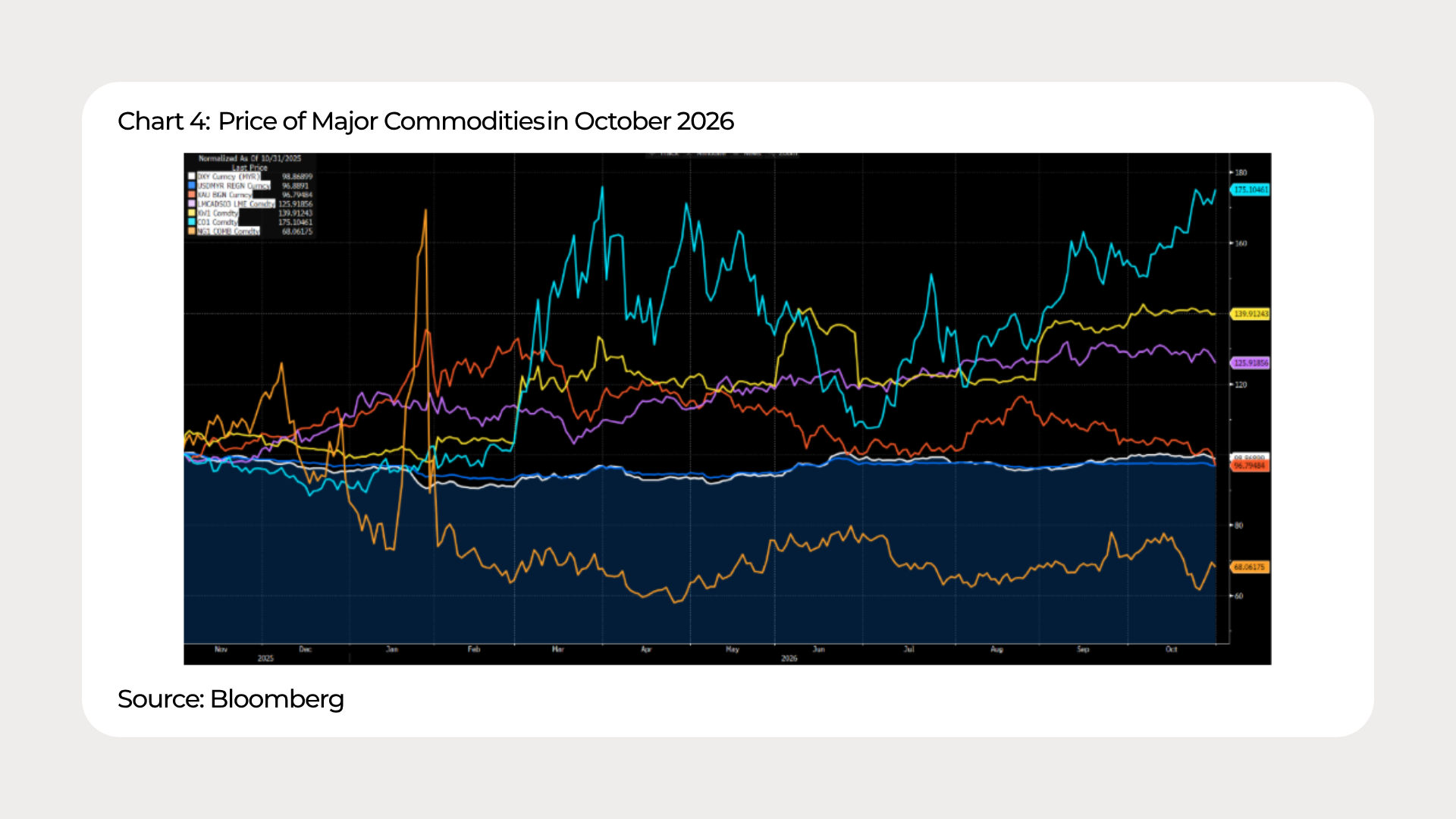
Commodity and currency markets delivered mixed performance in October, reflecting heightened geopolitical tensions, shifting monetary policy expectations and concerns over global economic growth.
The US Dollar Index (DXY) strengthened by 0.42%, supported by expectations of further Federal Reserve tightening and demand for dollar-denominated assets. Despite the stronger US Dollar, the Malaysian Ringgit appreciated 0.53% against the greenback, reversing part of September's depreciation and demonstrating relative resilience amid global uncertainty.
Crude oil emerged as the strongest-performing commodity, surging 19.30% following a 15.69% increase in September. The continued rally reflected escalating US-Iran tensions and concerns over potential supply disruptions through the Strait of Hormuz, renewing inflationary pressures and complicating the outlook for global monetary policy.
Other energy commodities recorded mixed performance, with coal rising 2.10%, potentially supported by energy supply concerns, while LNG declined 18.98% amid differing supply-demand conditions. Meanwhile, copper fell 2.68%, reflecting cautious sentiment towards industrial demand and global economic growth despite longer-term support from electrification and AI-related infrastructure investment.
Gold declined 7.42%, extending September's 5.53% loss, as a stronger US Dollar and expectations of further monetary tightening outweighed traditional safe-haven demand. The decline highlighted investors' preference for interest-bearing assets amid uncertainty over future policy rates.
Overall, October's commodity performance reflected the contrasting effects of geopolitical supply risks and weaker growth expectations, with energy prices remaining a key influence on global inflation and monetary policy.
How Has It Impacted Malaysia?
For Malaysia, October's market environment presented both opportunities and challenges amid heightened geopolitical tensions, shifting monetary policy expectations and global market volatility.
Higher crude oil prices could support petroleum-related revenue and benefit selected energy companies. However, sustained increases in energy costs may also raise inflationary pressures, production expenses and government subsidy commitments, potentially affecting domestic consumption and corporate profitability.
Despite the global equity market sell-off, Malaysia's FBM KLCI demonstrated relative resilience, declining 1.89% compared with sharper losses in technology-heavy Asian markets. Meanwhile, the Ringgit appreciated 0.53% against the US Dollar, reflecting relative currency stability amid external uncertainties.
In the fixed income market, the 13 basis point decline in the 10-Year Malaysian Government Securities (MGS) yield supported domestic bond valuations, reinforcing the diversification benefits of fixed income investments during periods of equity market weakness.
Looking ahead, Malaysia's Budget 2027 initiatives and resilient domestic demand could provide support to economic growth, particularly in banking, consumer-related and infrastructure sectors. Nevertheless, global interest rate developments, commodity prices and foreign capital flows will remain key factors influencing Malaysia's financial markets.
Market Outlook
Looking ahead, three key themes are likely to influence global financial markets during the remaining months of 2026.
First, global monetary policy will remain a key focus as investors assess the possibility of further interest rate increases, particularly by the Federal Reserve in December. While government bond yields declined in October, persistent inflationary pressures from elevated energy prices could limit further bond market gains and contribute to continued volatility.
Second, the outlook for technology and AI-related equities remains uncertain following October's sharp correction. Despite strong long-term growth prospects, elevated valuations and concerns over the sustainability of AI-related capital expenditure could weigh on near-term performance. Investors are likely to place greater emphasis on corporate earnings and profitability.
Third, geopolitical developments in the Middle East will continue to influence energy prices and global investor sentiment. Any de-escalation in US-Iran tensions could ease oil prices and inflationary pressures, while prolonged disruptions may sustain higher energy costs and increase market volatility.
For Malaysia, resilient domestic demand and initiatives under Budget 2027 could provide some support against external uncertainties. Nevertheless, global interest rate movements, commodity prices and foreign capital flows will remain key market drivers, reinforcing the importance of maintaining a diversified investment portfolio.
Ria Reminder: Market Volatility Creates Opportunities. Is Your Portfolio Well-Diversified?
October 2026 highlighted how quickly market sentiment can shift, as global equities faced heightened volatility amid geopolitical tensions, monetary policy uncertainty and concerns over elevated technology valuations. While equity markets experienced downward pressure, fixed income investments demonstrated resilience as government bond yields declined.
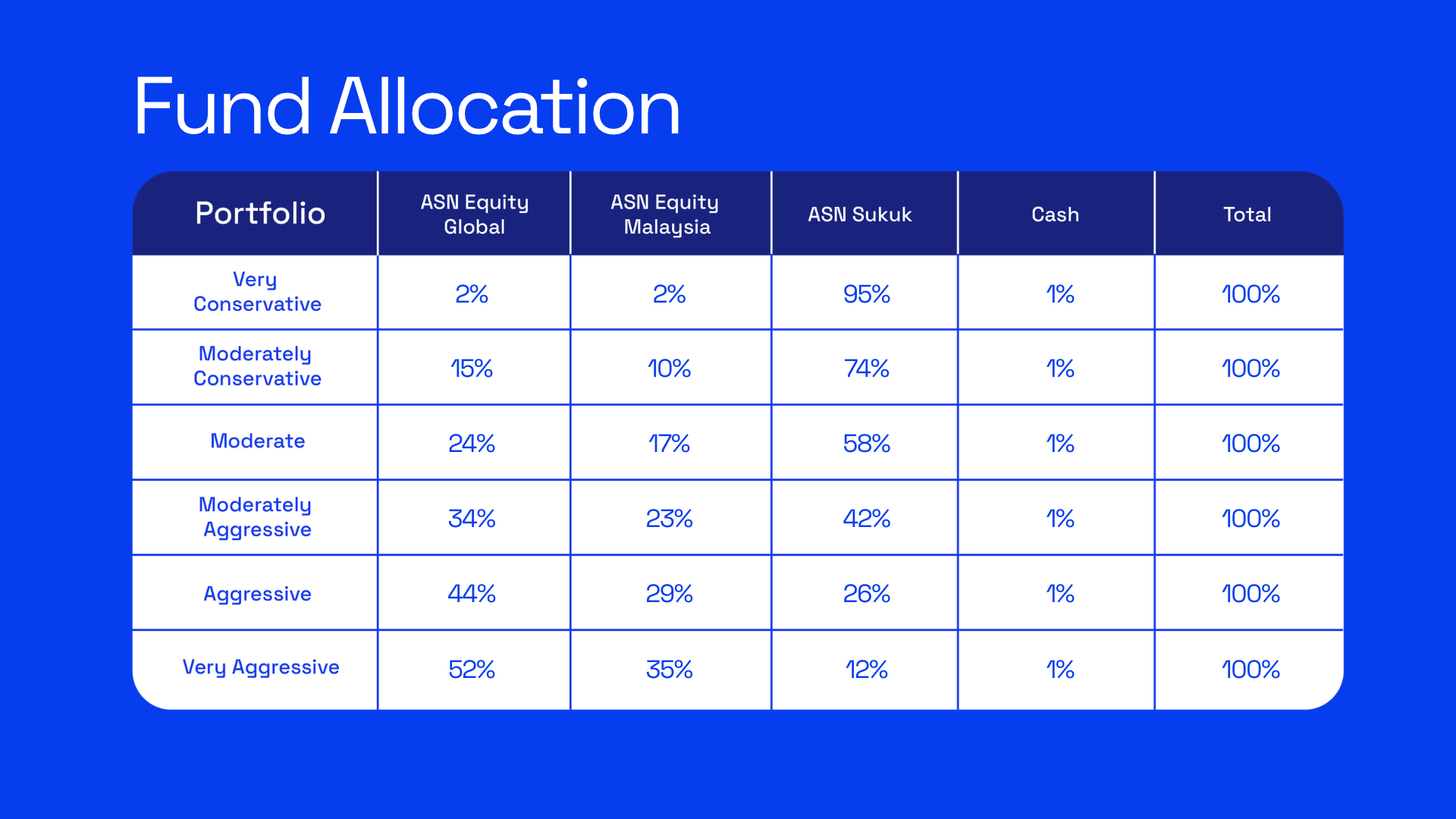
These contrasting market movements reinforce the importance of diversification, as different asset classes respond differently to changing economic conditions. By spreading investments across equities, sukuk and cash, investors can better manage portfolio risks while maintaining exposure to potential long-term growth opportunities.
Why Diversification Matters During Market Volatility
Market volatility is an inevitable part of investing. However, concentrating investments in a single asset class may expose portfolios to greater fluctuations when market conditions change.
A well-diversified portfolio helps balance growth potential and downside risks by combining assets with different risk and return characteristics.
- Equities – Long-Term Growth Potential: Global and Malaysian equities offer opportunities for capital appreciation, although they may experience greater short-term volatility during market corrections.
- Sukuk – Income and Stability: Sukuk can provide income potential and help diversify equity market risks, although they remain subject to market and credit risks.
- Cash – Liquidity and Flexibility: Cash allocations can help reduce overall portfolio fluctuations and provide liquidity during uncertain market conditions.
By combining these asset classes, investors can build a more resilient portfolio without relying excessively on the performance of any single market.
Does Your Portfolio Match Your Risk Tolerance?
While diversification is important, there is no single asset allocation that suits every investor. The appropriate balance between equities, sukuk and cash depends on individual financial goals, investment horizons and risk tolerance.
Conservative Investors
Investors with lower risk tolerance may prefer greater exposure to sukuk and cash to prioritise capital preservation and reduce portfolio fluctuations, while maintaining limited equity exposure for potential growth.
Moderate Investors
Investors with moderate risk tolerance may benefit from a balanced allocation between equities and sukuk, seeking long-term capital appreciation while managing potential downside risks.
Aggressive Investors
Investors with higher risk tolerance and longer investment horizons may maintain greater equity exposure to capture long-term growth opportunities, while retaining sukuk and cash allocations for diversification and liquidity.
Understanding your risk tolerance helps ensure that your investment portfolio remains aligned with your ability and willingness to withstand market fluctuations.
Stay Diversified, Stay Focused on Your Long-Term Goals
October's market correction serves as a reminder that market conditions can change unexpectedly. Rather than reacting to short-term movements, investors should periodically review their portfolio allocations to ensure they remain aligned with their financial objectives and risk tolerance.
Diversification does not eliminate investment risks or guarantee positive returns. However, maintaining an appropriate mix of asset classes can help manage portfolio volatility and support a more disciplined investment approach.
Remember: Successful long-term investing is not about predicting every market movement but about building a diversified portfolio that matches your risk tolerance and financial goals.
Log in to Ria today to review your portfolio and explore the benefits of diversification in balancing investment risks and long-term growth opportunities, in line with your risk tolerance and financial goals.