
Unexpected Emergencies? Be Prepared with ASB

Losing a job, having a car or house damaged, a child falling ill, and facing various other unforeseen emergencies can certainly affect our financial situation if we do not have savings to deal with such unexpected circumstances.
Without an emergency fund to fall back on, we may be forced to borrow money, accumulate debt, rely on credit cards or, in more extreme cases, seek financial assistance from loan sharks.
However, we often fail to realise the importance of having an emergency fund until we are actually faced with an unexpected situation. While emergencies can happen without warning, being financially prepared can help us manage them more wisely and effectively.
What Is an Emergency Fund?
An emergency fund is money set aside specifically to cover essential and unexpected expenses, such as job loss, emergency medical treatment, car breakdowns and various other unforeseen needs.
An emergency fund is essential because it forms the foundation of a strong financial position. Without one, your finances may be fragile and could easily become unstable when unexpected circumstances arise.
The COVID-19 pandemic demonstrated how income can be disrupted suddenly and without warning. Many people were forced to seek alternative sources of income, cut down on expenses, and obtain temporary assistance to meet their daily needs.
This experience serves as a reminder that an emergency fund is important because it provides a financial cushion, giving us time and flexibility to adjust to changing circumstances.
The Ideal Amount for an Emergency Fund
Generally, the recommended ideal amount for an emergency fund is equivalent to at least six months of your current salary. This is to ensure that you can cover your expenses for at least six months in the event of unforeseen circumstances, particularly if you lose your job.
However, the actual amount depends on factors such as income stability, the number of dependants, monthly financial commitments and existing financial protection. Self-employed individuals or those with irregular income may need to set aside a larger amount in savings.
Although the minimum target of six months' salary may seem substantial, it is achievable with discipline and consistency. Building savings does not require a large initial investment. Instead, you can start with as little as RM50 per month.
Choose Your Investment Destination
You may consider ASB as one of the investment instruments for building a portion of your emergency fund, particularly for funds that are not required immediately. At the same time, it is advisable to keep some money in a bank account to cover expenses that require immediate payment.
The following features make ASB a suitable option for an emergency fund:
1. Fixed Price Helps Maintain Value Stability
ASB is offered at a fixed price of RM1.00 per unit. Unlike variable price funds, whose values fluctuate according to market conditions, ASB's fixed price feature provides a degree of stability that may be more suitable for funds that could be needed during emergencies.
2. Start with a Small Amount
The minimum initial investment required to invest in ASB is only RM10. In addition to investing through ASNB branches and agents such as Maybank, CIMB Bank, Pos Malaysia and RHB Bank, you can also invest online through the myASNB application.
Meanwhile, through the Auto Labur feature, you can set up automatic investments starting from as little as RM30 per month. This feature helps make investing a consistent monthly commitment, allowing you to maintain your long-term investment habit with minimal effort.
3. Easy Access to Funds When Needed (High Liquidity)
An emergency fund should be easily accessible whenever the need arises. Although withdrawing funds from ASB may not be as convenient as using an ATM, withdrawals can be made almost immediately through ASNB agents and branches.
You can also withdraw funds through the myASNB application, which has a maximum monthly withdrawal limit of 10,000 units. The money will be credited to your registered bank account within up to 10 working days.
4. Potential to Earn Annual Dividend
ASB has a track record of delivering competitive annual income distributions relative to its benchmark since its inception. However, dividend rates may vary from year to year and are subject to the fund's performance, which is influenced by domestic and international economic conditions.

Invest Consistently Every Month
You can start building your emergency fund with a small amount, especially if you are still young. This is because a longer investment period allows the power of compounding to grow your investment more rapidly over time.
The key is to leave both your investment capital and dividends untouched throughout the investment period.
Do not let the perception that small investments make little difference discourage you from getting started. Remember the saying, “slow and steady wins the race”.
Set Your First Goal, Then Your Second, and So On
Setting progressive savings targets may be a more effective way to help you build your emergency fund. Start by aiming to accumulate RM1,000 in emergency savings.
Once you have achieved this target, move on to your second, third and subsequent goals until investing becomes a regular habit in your life.
Refer to the table below for an illustration of how much you could accumulate in your emergency fund by investing as little as RM50, RM100 or RM200 per month.
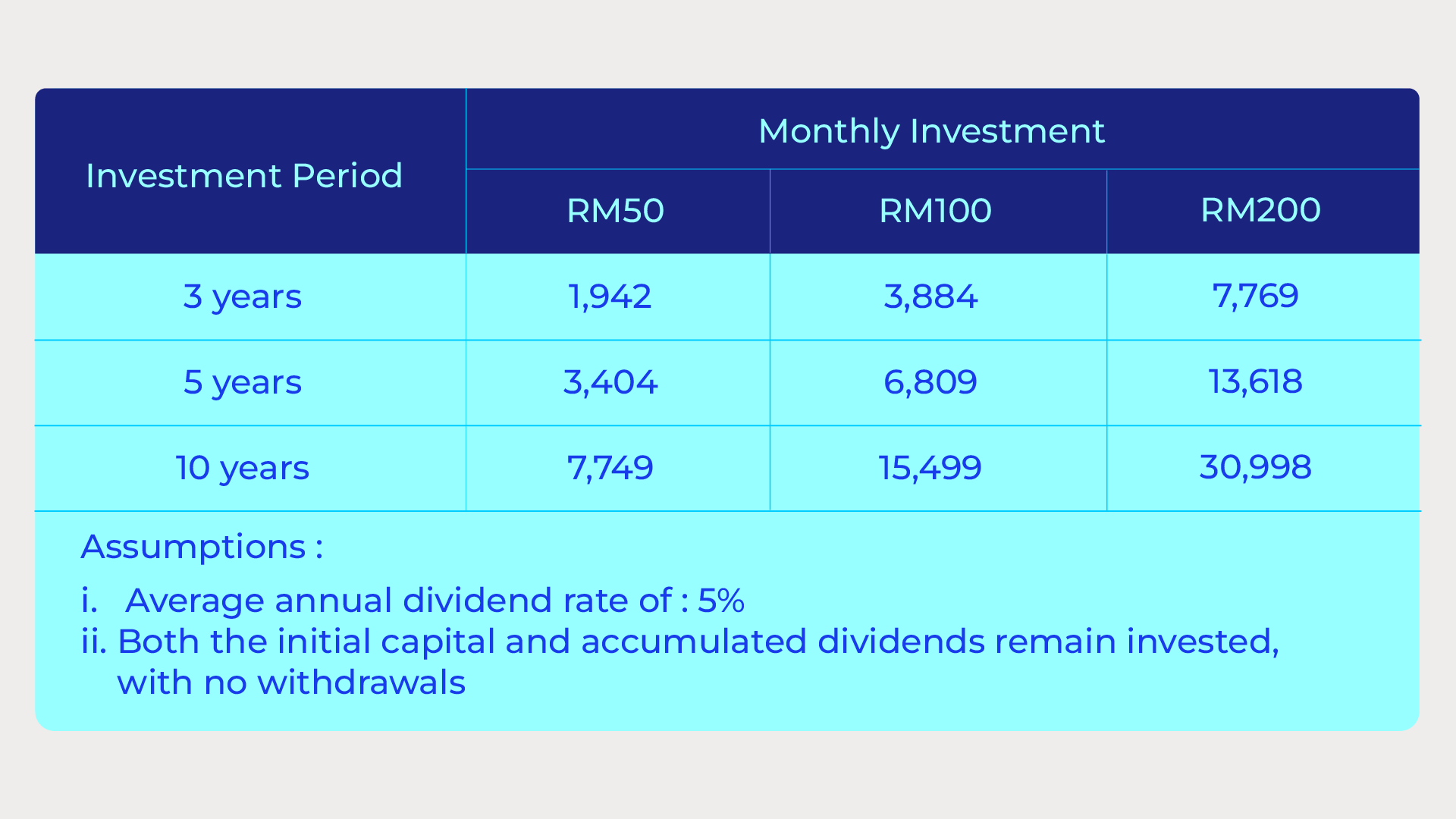
As you can see, investing as little as RM50 per month is sufficient to reach your first RM1,000 savings milestone within three years.
Although building an emergency fund may take time and the amount may seem modest at first, having one is far better than being forced to borrow money or experiencing financial stress when you need support the most.
Let's start investing in ASB to build your emergency fund while enjoying the various value-added services offered by ASNB.