
Enjoy a Comfortable Retirement

Every month, most of our living expenses are covered by our salary, including housing and car installments, household expenses, children's education and other financial commitments.
However, the time will eventually come when we retire and no longer receive a regular salary as we do today.
For those who are still young, retirement may seem a long way off. Nevertheless, it is never too early to plan and prepare for a future that can sometimes be unpredictable.
Retirement Is More Than Just Stopping Work
Many people envision retirement as a time to relax, spend quality time with family, pursue their favourite activities or fulfil long-awaited dreams.
However, retirement does not mean that you no longer need money to sustain your lifestyle. It means continuing to live without relying on a monthly salary, but instead depending on other sources of income, such as retirement savings and supplementary income.
Although some financial commitments may have decreased by then, other expenses will remain. These include:
- Food and daily necessities
- Utility bills and home maintenance
- Medical and healthcare expenses
- Takaful or insurance coverage
- Transportation
- Financial support for family members
- Social activities, religious commitments and holidays
- Emergency expenses
Unless you are prepared to continue working hard for the rest of your life, building retirement savings and developing relevant skills are among the ways to ensure a comfortable life in your golden years.
Therefore, retirement should be viewed as a long-term financial goal, rather than something to consider only when you are approaching the age of 60.
Most working individuals have retirement savings or pension funds through the Employees Provident Fund (EPF).
However, will the amount accumulated by the time we reach retirement be sufficient to support our desired lifestyle?
This is a question worth considering today. The earlier you decide to start building a second retirement fund, the greater the savings you can potentially accumulate.
Someone who starts at the age of 25 has approximately 35 years to build their retirement fund before reaching 60. In contrast, someone who starts at 45 has only about 15 years left.
The following illustrates how the age at which you start investing can affect the estimated amount of savings accumulated:
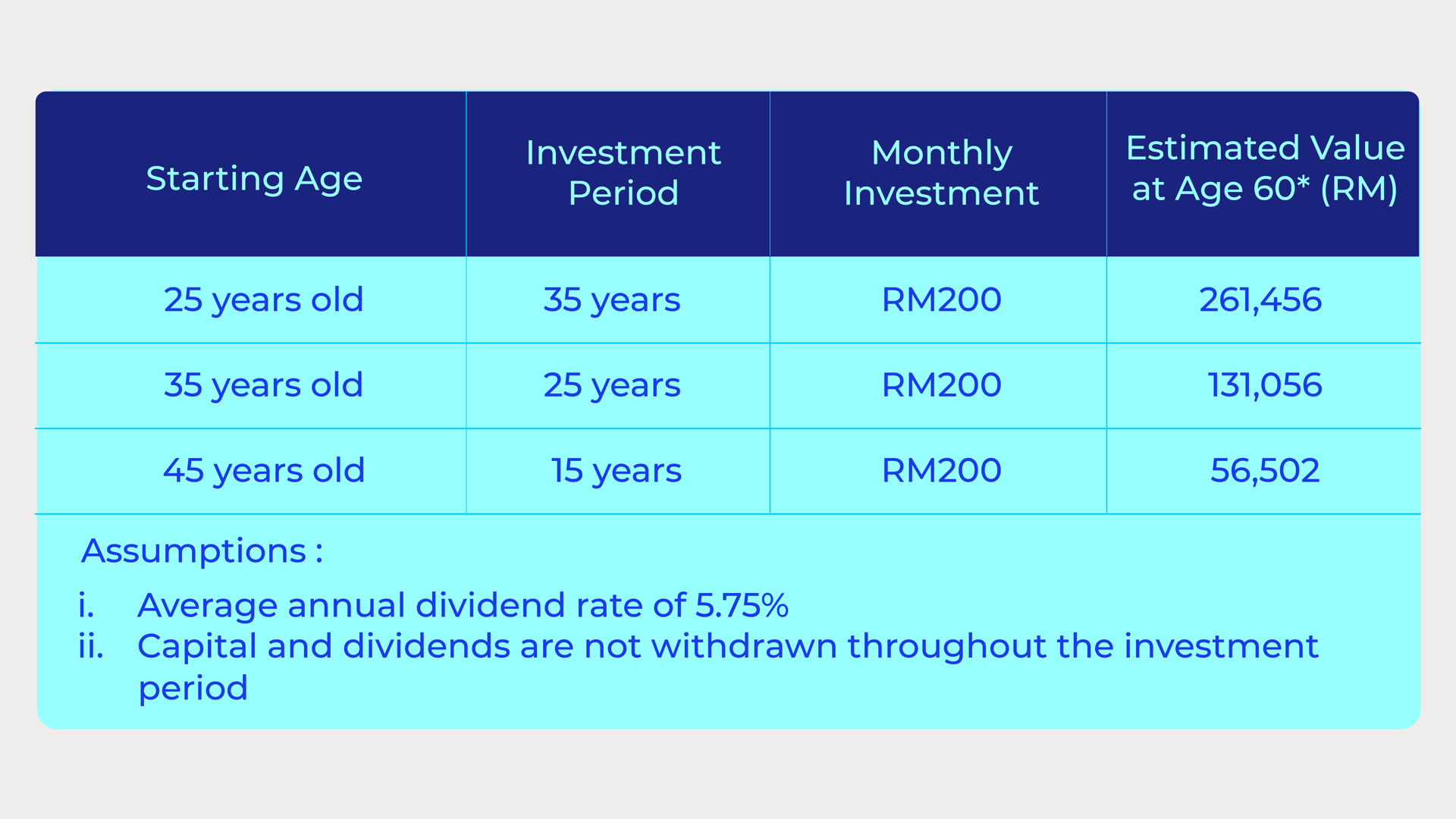
Although all three individuals invest the same monthly amount, their final outcomes differ because their investment periods are not the same. The individual who starts at the age of 25 has more time to grow their capital and benefit from the effects of compounding.
This does not mean that someone who starts at 35 or 45 is too late. Rather, the later one starts, the more important it becomes to reassess their goals, increase their investment amount where possible and manage their expenses more effectively.
The best time to start may be when you receive your first salary. However, if that opportunity has passed, the next best time to start is now.

Choosing Financial Instruments for Retirement Savings
Amanah Saham Bumiputera (ASB) can be one of the investment instruments used to build an additional retirement fund. As a fixed-price fund, ASB focuses on price stability and income generation, in line with long-term financial goals.
The Auto Labur facility through myASNB allows unit holders to set up automatic investments based on their preferred amount, date and frequency. This helps develop a more consistent investment habit without having to remember to make transactions every month.
For example, an individual can set up an automatic investment of RM200 per month. This way, the amount is set aside before being allocated to other expenses.
However, the amount must be realistic and sustainable. Investing consistently at RM100 per month is better than committing to RM500 but having to withdraw the money or discontinue the investment after a few months.
Start with an Amount You Can Sustain
The minimum initial investment for ASB is RM10. This allows individuals to start investing without having to wait until they have a substantial amount of surplus cash.
For example, a young working professional can start with RM100 per month. When they receive a salary increase, the amount can be increased to RM150 or RM200. A portion of bonuses, allowances or additional income can also be channeled into their retirement fund.
This approach is more realistic than setting an excessively high amount at the beginning that becomes difficult to maintain. The key is to develop the habit of investing every month, rather than investing only when there is money left over after all expenses have been paid.
Whenever you receive a salary increase, consider increasing your investment amount instead of significantly upgrading your lifestyle.
Building a retirement fund is not a one-time process that can simply be left unattended. Your plan needs to be reviewed from time to time. At least once a year, ask yourself the following questions:
- Is my monthly investment amount still appropriate for my current income?
- Can I increase my investment amount?
- Are funds frequently withdrawn for other purposes?
- What will my estimated monthly expenses be after retirement?
- Is my health and takaful coverage sufficient?
- Is my investment portfolio still aligned with my investment horizon and risk tolerance?
A more secure retirement does not begin on the last day of employment. It is built through small decisions made throughout our working years.

A monthly investment of RM50, RM100 or RM200 may seem small today. However, when invested consistently over several decades, these amounts can grow into a fund that helps support your retirement in the golden years.
Your salary may eventually come to an end, but as a savvy investor who manages finances wisely from the very first paycheck, you can look forward to a more confident, comfortable and dignified retirement.
Note: The investment calculations in this article are for illustrative purposes only. The assumed average annual dividend rate of 5.75% is not a guaranteed ASB return. Any income distribution is subject to the fund's performance and the approval of the trustees.